


We spent fifteen years running client support every way it can be run. Then we built the helpdesk we actually wanted — and made it a product.
For about fifteen years, support requests have reached me every way a request can travel. Email. Text message. A phone call at 7:40 on a Saturday morning. A comment on an invoice. Occasionally a note handed to me in a parking lot. Every one of those was a real problem for a real client, and every one of them needed to end up in the same place: a list I trusted, with nothing quietly falling off the bottom of it.
I tried the usual answers. The big helpdesk platforms are genuinely capable, and they’re also priced and shaped for a support department — per-agent seats, tiered add-ons, a settings tree deep enough to get lost in, and a quarterly bill that climbs whether or not the ticket volume did. The small tools went the other direction: cheap and simple right up to the point where you need a second client, a shared inbox, or a report you can hand to somebody.
So I built the thing I wanted. It’s called Ravine Desk, it’s live at ravinedesk.com, and this is the introduction. Here’s what it looks like — click any screen for a closer look:
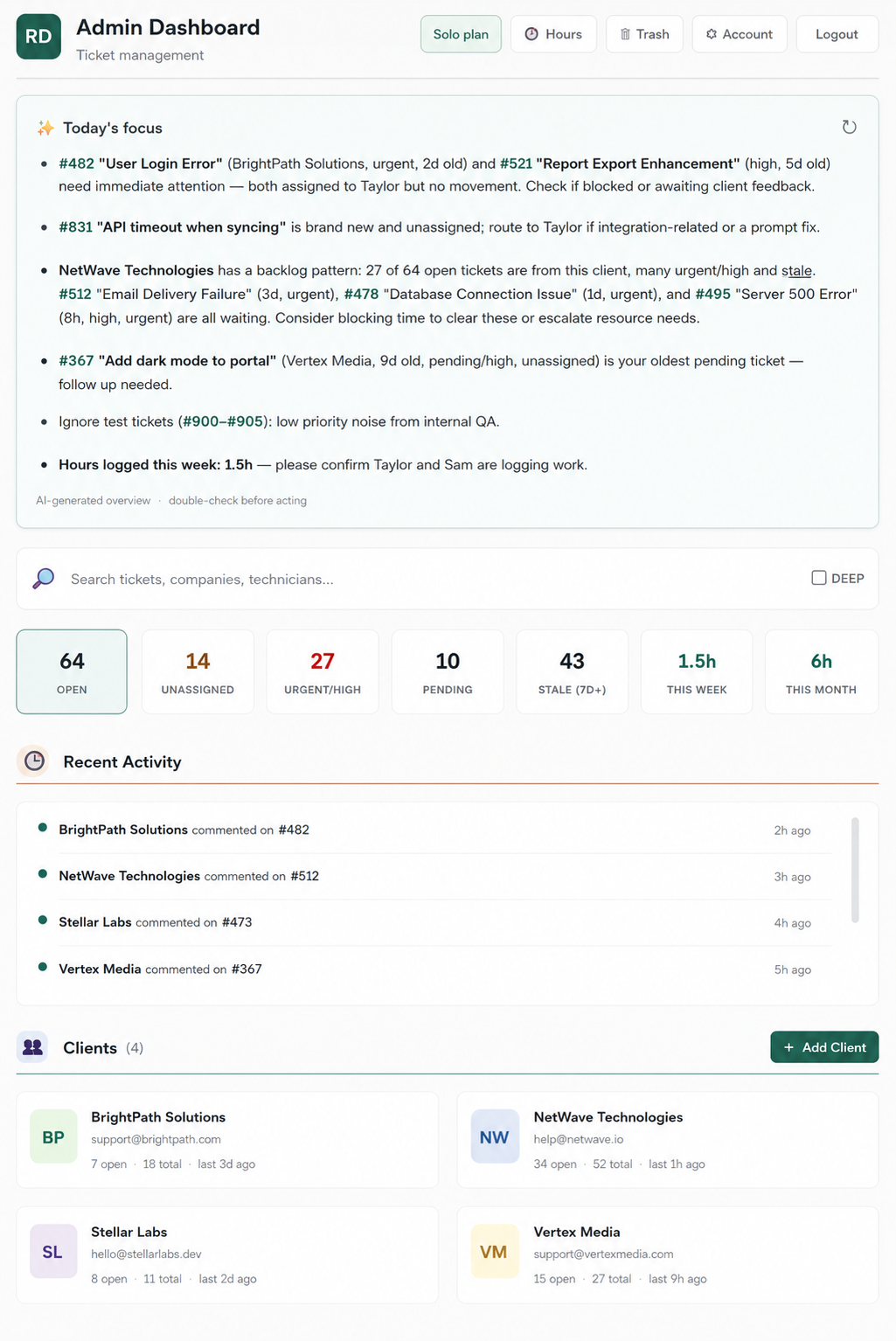
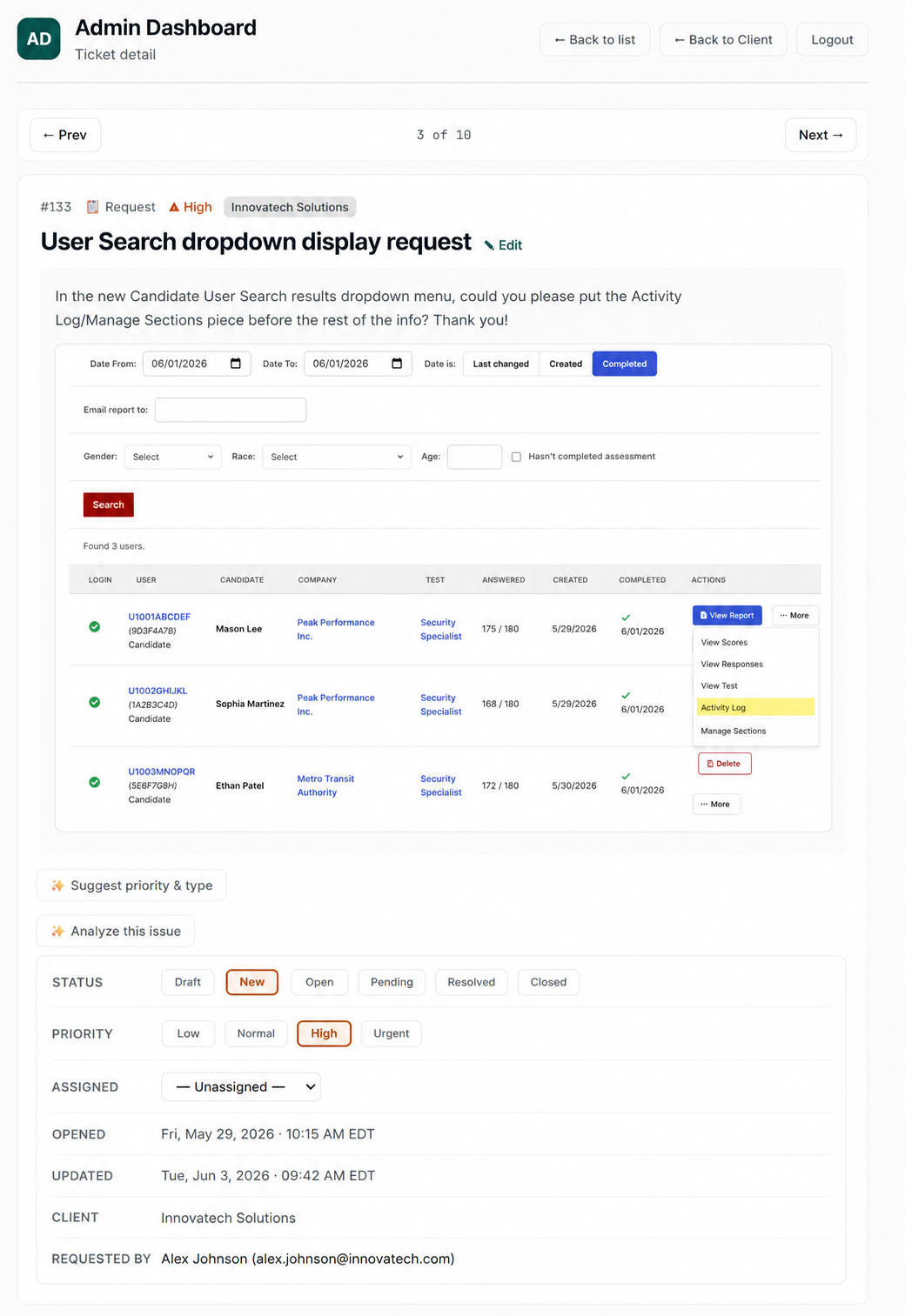
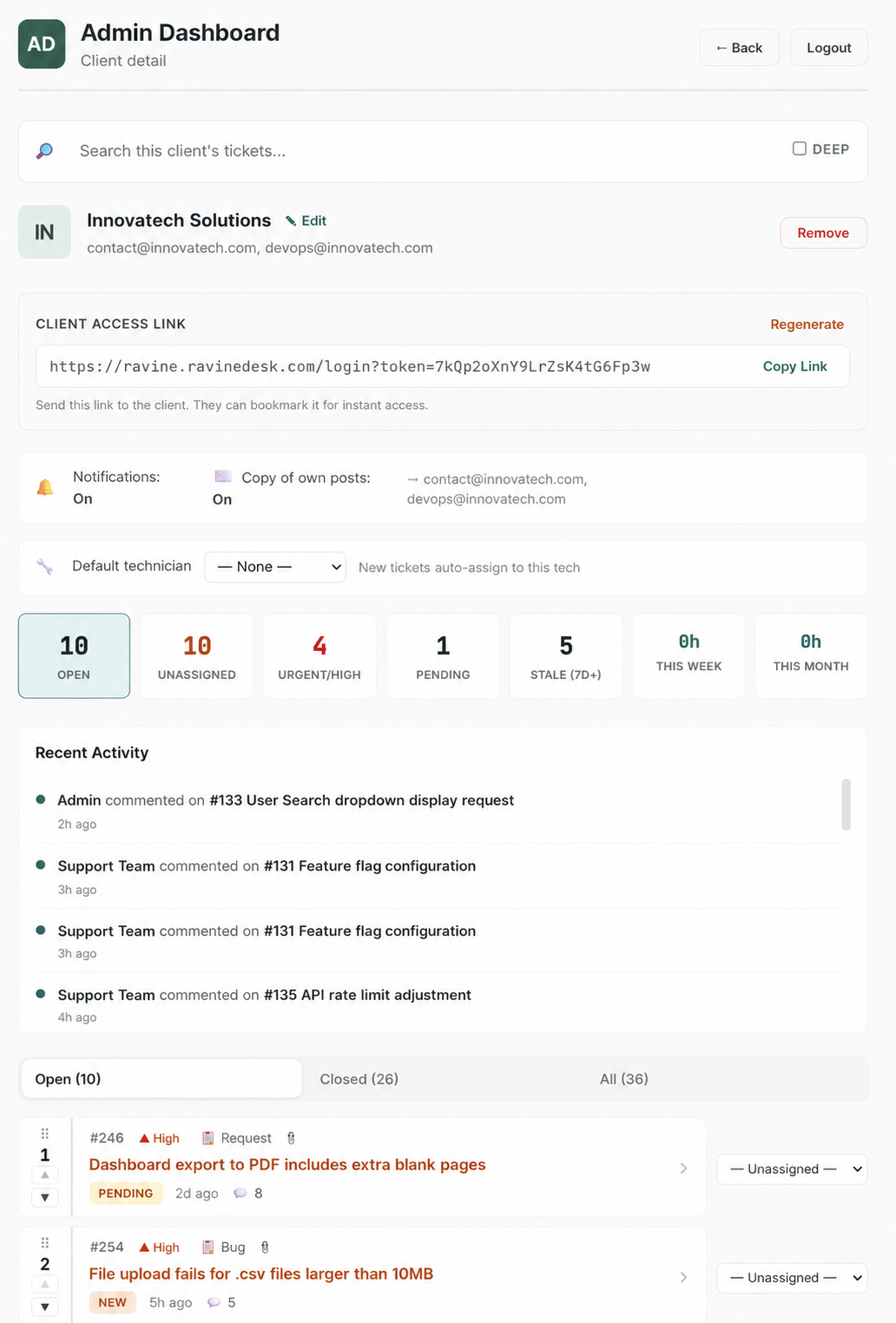
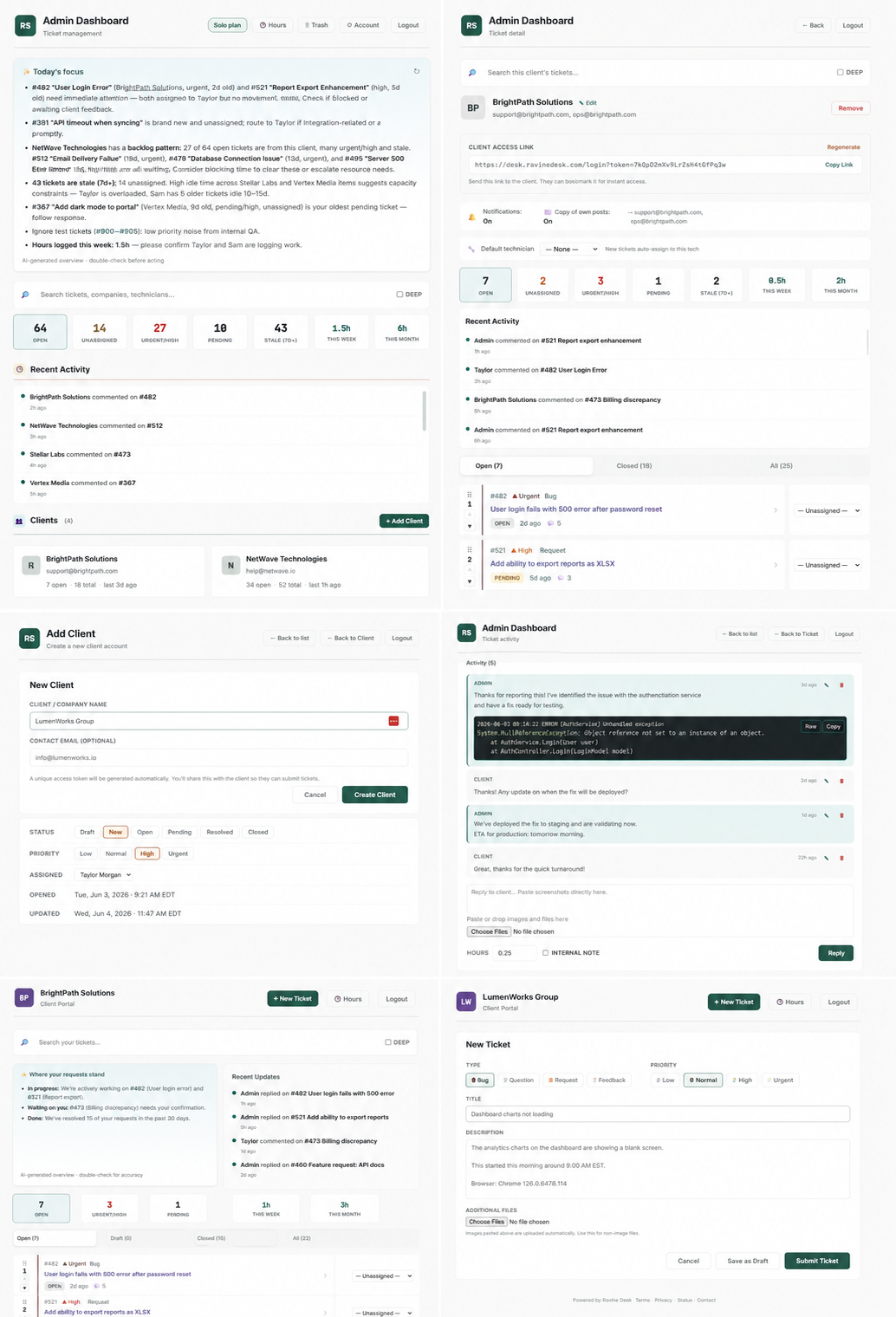
The admin dashboard with its AI briefing, a client feature request as a ticket, the client detail view, and a tour of the rest.
What it is
Ravine Desk is a hosted, multi-tenant helpdesk for small teams that support other people — MSPs, agencies, internal IT, software shops, anyone whose day is partly other people’s emergencies.
Each organization gets its own subdomain (yourcompany.ravinedesk.com), its own users, and its own data. Requests come in, they become tickets, tickets get assigned and answered and closed, and the history stays searchable. That’s the whole promise. The interesting part isn’t the concept — it’s the decisions underneath it.
What’s different about it
One monthly price. No per-ticket fees, no per-client fees. This is the part I care most about. The industry standard is to charge you for volume — more tickets, more contacts, more of everything you can’t control — which means your bill goes up precisely on the months when you’re already underwater. Ravine Desk doesn’t work that way. You pick a plan based on how many technicians you have, and that’s the number on the invoice. Tickets are unlimited on every tier, starting at $12/month for a one-person shop.
Tickets arrive however people want to send them. Clients don’t want to learn a portal. They want to reply to an email, and Ravine Desk takes inbound mail, threads it onto the right ticket, and keeps replies flowing through the conversation the customer was already having. There’s also a support widget you can drop onto any website — a few lines of embed code — that collects requests into a general queue. That one matters more than it sounds like it should: it catches the people who don’t have a login and were never going to get one, the ones who would otherwise have found your contact form, or not bothered. The portal is there when someone wants it, not as a toll booth.
AI that’s included, not upsold. Every plan — including the $12 one — comes with the AI assistant. It writes you a briefing on what’s waiting, analyzes an issue that’s grown to forty messages and tells you what’s actually going on, and on the larger plans it triages incoming tickets and produces per-client status summaries. What it doesn’t do is talk to your customers for you. It reads, sorts, and explains; you decide and reply. If you burn through more AI than your plan includes, there’s a Boost pack — but the assistant isn’t a feature you have to climb a pricing tier to reach.
Built to be boring in the right places. ASP.NET Core, SQL Server, Stripe for billing, Postmark for mail delivery, Cloudflare R2 for attachments. Nothing exotic, nothing I can’t reason about at 2 a.m. That’s a feature when the product’s job is to be reliable.
Who it’s for
If you’re supporting somewhere between one and a few dozen client organizations and your current system is a shared inbox plus a spreadsheet plus a good memory, Ravine Desk is aimed squarely at you. Same if you’re a small internal IT team that got handed a request queue and a mandate to “get organized” without a budget line for enterprise software.
If you’re running a hundred-agent contact center with a workforce-management integration, be honest with yourself — you want one of the big platforms, and I’d tell you the same thing on a sales call.
Where it came from
Ravine Desk is a product of Ravine Software, the consultancy I’ve run out of East Tennessee since well before “SaaS” was a word people said out loud. Most of what’s in it exists because I needed it first: I run my own client support on it. When something is awkward, I feel it that same week, and it usually gets fixed.
But a good portion of it exists because somebody else needed it. My support clients have been using this system the whole time it was being built, and they didn’t stay quiet about it. Someone would open a ticket about a printer, and at the bottom of it add a line about how they wished they could see all their open requests in one place, or get a notification when something changed, or attach a photo from their phone without fighting the upload. So we’d build it. The feature request arrived as a ticket, went into the same queue as everything else, and shipped — sometimes within the week.
That loop is the reason I trust the product. It wasn’t shaped by a persona document or a competitor’s feature grid; it was shaped by the actual people submitting actual tickets, telling us in plain language what was in their way. What’s good for them turns out to be good for us, and vice versa, which is a rarer alignment in software than it ought to be.
That’s also the honest pitch for using a small product from a small company. You’re not going to get a 24/7 follow-the-sun support org. You are going to get a real person who wrote the code, reads the tickets, and can tell you whether your feature request is on the roadmap or isn’t — instead of routing you to a form.
Try it
There’s a 14-day free trial, no credit card required. Set up a subdomain, point an email address at it, run a week of real tickets through it, and see whether it fits how you actually work. If it doesn’t, I’d like to hear why — that feedback has shaped more of this product than any roadmap document has.
One note on timing: the prices up right now are founding rates, and they’re lower than where the plans will settle. If you sign up during this window, that’s the rate you keep.