
Every business is being told to “adopt AI.” Almost nobody is being told what that means for their specific systems, data, and risks. That’s the gap a readiness assessment closes.
An AI readiness assessment isn’t a sales pitch with extra steps. Done honestly, it’s a structured look at your operation that ends in a prioritized roadmap — including, sometimes, the recommendation to wait. Here’s what we actually examine when we do one.
1. Where your time actually goes
AI creates value by removing repetitive knowledge work — reading, sorting, drafting, extracting, summarizing. So the first question isn’t “what could AI do?” It’s “what does your team do all week?” We look for the tasks that eat hours and follow patterns: processing documents, answering the same categories of email, moving data between systems by hand, writing routine reports. Those are the candidates. A task that’s rare, unpredictable, or high-judgment usually isn’t.
2. Whether your data can support it
Most AI disappointments are data problems wearing a costume. If the information an AI would need lives in seventeen spreadsheets, three inboxes, and one employee’s memory, no model will perform well against it. Part of the assessment is mapping where your operational data actually lives, how clean it is, and what plumbing would be needed to make it usable — which is classic systems work, and often valuable even if you never touch AI.
3. What a mistake would cost
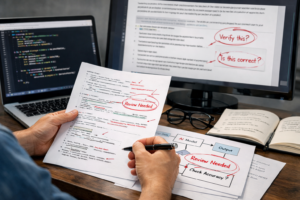
This is the piece the hype skips. AI systems are probabilistic: they are sometimes wrong, confidently. So for every candidate task, we ask what happens when the output is wrong. A mis-sorted support ticket costs a minute. A mis-stated price, a hallucinated policy answer, or a bad number in a compliance report costs real money and real trust. The answer determines the design: where AI can act on its own, where it drafts for a human to approve, and where it doesn’t belong at all.
4. What it will actually cost to run
Not just the API bill — the integration work, the evaluation and monitoring, and the maintenance as models and your business both change. We put honest numbers next to each opportunity so you can compare them the way you’d compare any investment: what it saves, what it costs, and how sure we are about both.
What you walk away with
The deliverable is a plain-English roadmap: the two or three automations genuinely worth building first, the data groundwork they depend on, the risks and guardrails each one needs, and the ideas we recommend skipping — with reasons. Build with us, build with your own team, or sit on it for a year. Like everything we do, the clarity is yours to keep.
If your team is spending hours on work that follows a pattern, let’s talk about an AI readiness assessment — or read more about our AI integration practice.